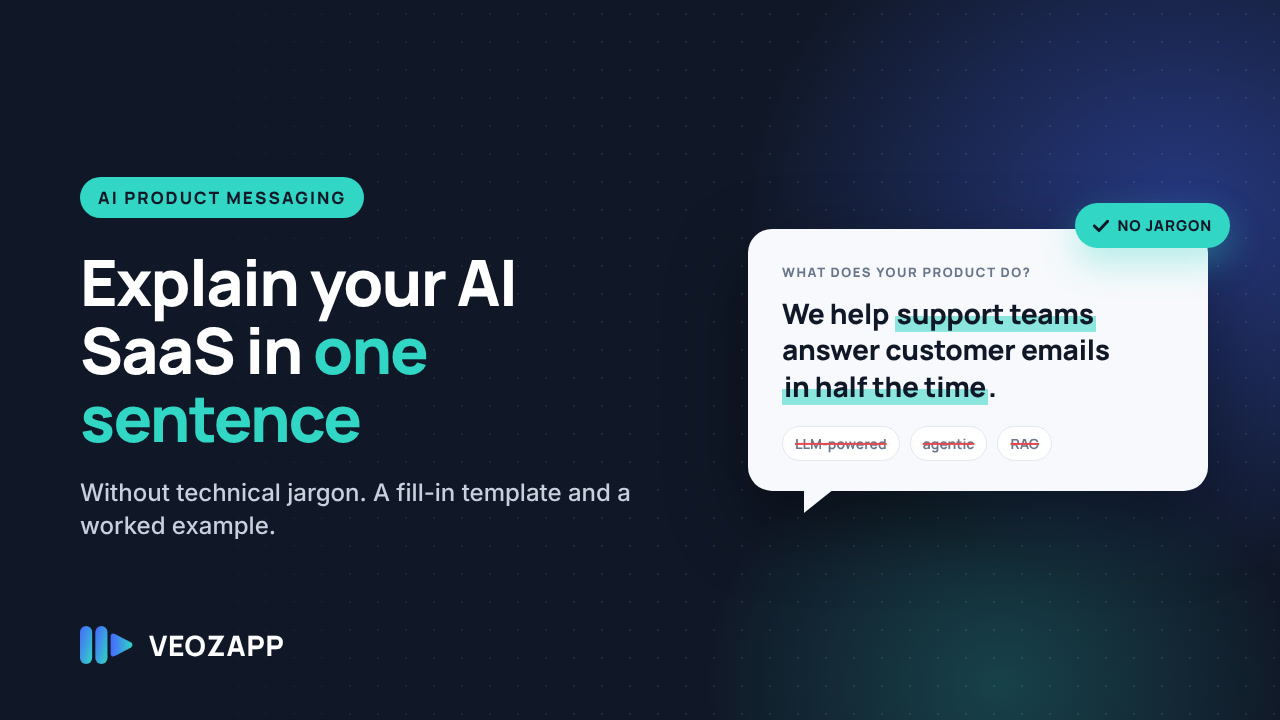
Someone asks what your product does.
You start with “It’s an AI-powered platform that leverages large language models to…” and you can see their attention drift before you reach the end of the sentence.
This is the most common problem for founders of AI products. You know exactly how the product works, so you describe the mechanism.
Buyers do not care about the mechanism yet. They want to know three things:
- is this for me?
- what problem does it solve?
- what changes if I use it?
This guide gives you a repeatable method to write one sentence that answers those three questions in plain language.
By the end you will have a tested sentence you can use on your homepage, in your LinkedIn bio, in cold emails and as the opening line of a product video.
What you need before you start
Set aside about 45 minutes and gather these inputs. You do not need anything else.
- Your current description. Copy the first sentence of your homepage, your app store or Product Hunt tagline, and how you described the product in your last sales call or email.
- One specific customer. A real or target customer you can picture clearly: their job title, team size, and what a bad day at work looks like for them.
- The task your product replaces or speeds up. Not the feature list, the actual task the customer was doing before.
- One honest outcome. What is concretely different after they use your product? Avoid numbers you cannot back up.
- Two or three people outside your industry. A friend, a relative, a founder in another field. You will test your sentence on them.
Step-by-step: write your one-sentence explanation
-
List every technical word in your current description
Take your current description and underline every word a non-technical buyer might not understand or might not care about: AI-powered, LLM, agent, RAG, model, fine-tuned, embeddings, pipeline, workflow automation, platform, leverage, seamless, intelligent.
These words are not banned forever, but they cannot carry the meaning of your sentence.
If you remove them and nothing is left, you have found the problem.
-
Name the person, not the market
“Businesses” or “teams” is too broad. Write who the product is for in a way your ideal customer would recognise themselves in.
Compare “for companies” with “for support teams of 2 to 10 people”.
The second version lets the right reader say “that’s me” and lets everyone else move on, which is a good thing.
-
Describe the task in the customer’s own words
Write the task the way your customer would describe it to a colleague.
Customers do not say “ticket resolution workflows”. They say “answering the same customer questions all day”.
If you have support emails, sales call notes or reviews, borrow their exact wording.
-
State what your product does as a visible action
Use a verb that someone could watch happen on screen: drafts, sorts, checks, summarises, fills in, flags, translates.
Avoid verbs that describe capability instead of action, such as “enables”, “empowers”, “transforms” or “optimises”.
If you could not film it, it is probably too abstract.
-
Add the outcome the customer cares about
Finish with what changes for the customer. Keep it honest and observable: fewer repetitive replies to write, faster first response, consistent answers across the team.
Do not invent percentages. If you do not have measured results, describe the change in plain terms.
-
Assemble the sentence with the template
Put the pieces into this structure: [Product] helps [specific customer] [do task] by [visible action], so they [outcome]. Your first version will be long. That is fine.
-
Cut it to 25 words or fewer
Read it aloud. Remove every word that does not change the meaning. Replace long phrases with short ones.
Aim for a sentence you can say in one breath, roughly 20 to 25 words.
-
Test it on someone outside your industry
Say the sentence once, then ask: “In your own words, what does this product do, and who is it for?” Do not explain or correct.
If they can repeat the customer and the task back to you, the sentence works. If they repeat a buzzword (“it’s some AI thing”), go back to steps 3 and 4.
Test with two or three people and adjust after each one.
Worked example: Replyhaven (a fictional product)
To make this concrete, we will use a fictional AI SaaS that we will reuse across Veozapp articles. Replyhaven is not a real company.
It is an AI customer-support tool for small support teams that drafts replies to customer tickets based on the team’s existing help documents.
Starting description (typical first draft):
Replyhaven is an AI-powered customer support platform that leverages large language models and retrieval-augmented generation to automate ticket resolution workflows at scale.
Step 1, technical words: AI-powered, platform, leverages, large language models, retrieval-augmented generation, automate, ticket resolution workflows, at scale. Remove them and almost nothing remains.
Step 2, the person: small support teams, typically 2 to 10 people, often at a software company.
Step 3, the task in their words: answering the same customer questions over and over, and looking up the right help article each time.
Step 4, the visible action: it writes a draft reply using the team’s own help articles. The agent reviews it and sends it.
Step 5, the outcome: agents spend less time typing repeated answers and replies stay consistent with the help centre.
Step 6, assembled (first version, 42 words):
Replyhaven helps small customer support teams who answer the same questions every day by writing a draft reply to each ticket using the team’s own help articles, which an agent can check and send, so they spend less time typing repeated answers.
Step 7, cut to 24 words:
Replyhaven drafts replies to customer tickets from your own help articles, so small support teams spend less time typing the same answers.
Step 8, test result: in a test like this, a listener who repeats back “it writes answers to customer emails using the help pages you already have” has understood it.
If a listener instead says “it’s a chatbot”, that is a signal to clarify that a human reviews and sends the reply. One possible adjustment:
Replyhaven drafts replies to customer tickets from your own help articles. Your team checks each one and sends it, without retyping the same answers.
This is technically two sentences, and that is acceptable. The goal is a single breath of explanation, not a grammar rule.
Your deliverable: the one-sentence explanation template
Copy this worksheet into a document and fill it in. The finished sentence at the bottom is your deliverable.
| Element | Question to answer | Your answer |
|---|---|---|
| Customer | Who exactly is this for? (role, team size, context) | |
| Task | What were they doing before, in their own words? | |
| Visible action | What does the product do that you could show on screen? | |
| Outcome | What is different for them afterwards, stated honestly? | |
| Words removed | Which technical or vague words did you take out? |
Sentence template:
[Product] [visible action] [for/from what], so [specific customer] [outcome].
Final checklist before you use it:
- 25 words or fewer.
- No word that a buyer outside your field would need to look up.
- Names a specific customer, not “businesses” or “everyone”.
- Uses a verb you could film.
- The outcome is true today, not a future roadmap promise.
- At least two people outside your industry repeated it back correctly.
Common mistakes
- Leading with the technology. “AI-powered” in the first three words tells the reader how it works before they know why they should care. If the AI matters, show it through the action (“drafts”, “sorts”), not the label.
- Trying to include every feature. One sentence explains one core job. Other features belong on the features page or later in a demo.
- Using category words that nobody searches for. Terms like “support intelligence layer” may sound distinctive, but the buyer has to translate them. Plain words win.
- Overclaiming. “Fully automates your support” is a promise that one bad answer can break. If a human stays in the loop, say so. It builds trust.
- Testing only with people who already know the product. Your co-founder, investors and current users will fill in the gaps for you. Strangers will not, and neither will a prospect skimming your homepage.
- Writing it once and never revisiting it. Revisit the sentence when you change your target customer or your main use case.
Where to use your sentence next
Once the sentence passes the test, use it consistently:
- as your homepage headline or subheadline;
- in your social profiles;
- as the first line of cold emails;
- as the opening line of any demo or product video.
Consistency matters more than cleverness. A visitor who reads the same clear sentence in three places remembers it.
You do not need a professional video to benefit from this exercise. A clear sentence plus a two-minute Loom walkthrough is often enough for early conversations.
When you do need a short explainer for your homepage or ads, this sentence becomes the backbone of the script.
Keep working on your explanation: test it, simplify it, and retest it as your product evolves.